
After the Container Moves: The First 36 Hours on the New Site
A relocated container is a new machine with an old serial number, and the first day and a half will tell you whether the move was clean. At 1 PH/s the credit should build to 0.00067291 BTC over 36 hours, worth $56.99 at $84,692. Anything short of that is a fact about the new site rather than about the pool.

Key takeaways
- Thirty-six hours at 1 PH/s should total 0.00067291 BTC, or $56.99 at $84,692 per coin.
- Each six-hour block adds 0.00011215 BTC; a short block locates the fault to a time window.
- Compare the new site's first full day against the last full day at the old one before celebrating or worrying.
- Two measurements belong in the move log: hashrate at the pool and hashrate at the miner, taken at the same minute.
A move changes the address, not the difficulty
Relocation is a physical event with a financial signature. The machines travel, the feed changes, the cooling is different, and the network is exactly where it was. That last point is the one that makes the first 36 hours readable: any gap between expectation and credit comes from the site, because the pool's arithmetic did not move with the truck.
This is why the bring-up window is worth measuring rather than eyeballing. A container that comes online at 96% of rated hashrate will look fine on a dashboard and will quietly cost 4% of revenue until someone finds the loose board. Thirty-six hours is enough time for every unit to be seen submitting shares and short enough to still remember what you changed. Take the reading from the pool, not from the machine's own web page, because the pool is the party that pays and the two views are rarely identical on the first day.
Six-hour marks as a bring-up checklist
The table treats each six-hour span as an acceptance item. The incremental column is the useful one: equal increments mean every unit is contributing, while a single thin increment points to the hours when something was offline.
| Window ending | Added in window | Cumulative BTC | Value so far | Read |
|---|---|---|---|---|
| Hour 6 | 0.00011215 | 0.00011215 | $9.50 | Warm-up |
| Hour 12 | 0.00011215 | 0.00022430 | $19.00 | Steady |
| Hour 18 | 0.00011215 | 0.00033645 | $28.49 | Steady |
| Hour 36 | 0.00022431 | 0.00067291 | $56.99 | Two clean days |
If the hour-18 total is right and the hour-36 total is not, the fault is in the second half of the window and the search is half as wide. If every increment is uniformly low, the site is under-delivering across the board and the cause is more likely power, cooling or a mis-set frequency than a single failed unit.
The slope matters more than the total
A total can be rescued by a strong finish. The slope cannot. Two containers can both reach 0.00067291 BTC in 36 hours while one of them spent four hours dark and then over-performed on a lucky share run, and the second pattern is the one that repeats next week. Look at the increments in order before you look at the cumulative line, and keep the raw numbers rather than a smoothed average, because the smoothing is what hides a four-hour gap.
The Pool Hashrate reading gives the slope a context. If the pool's total dropped while your increments dropped, the shortfall may be a pool-level event rather than a site-level one. If the pool is stable and your line is not, the problem is inside the fence. Write both numbers down at the same minute, because a comparison made from memory of two different moments is not a comparison at all.
Worked example: thirty-six hours on a new feed
Rebuild the acceptance number from the network figures, then check the increments.
- The network issues 450 ÷ 1,003,000,000 = 0.00000044865 BTC for every terahash, daily.
- Multiply by a thousand: 0.00044861 BTC a day at 1 PH/s.
- One hour is a twenty-fourth of that: 0.00044861 ÷ 24 = 0.00001869 BTC.
- Six hours: 6 × 0.00001869 = 0.00011214, carried as 0.00011215 to match the published rate.
- Thirty-six hours: 36 × 0.00001869 = 0.00067291 BTC.
- Dollars: 0.00067291 × 84,692 = $56.99.
- A four-hour gap in the second half removes 4 × 0.00001869 = 0.00007476 BTC, or $6.33, and leaves 0.00059815 BTC.
That last figure is the shape of a mediocre move: not a disaster, not a clean acceptance either. Finding it on day two is much cheaper than finding it at the end of the quarter, when the cause is a memory and the fix is a guess.
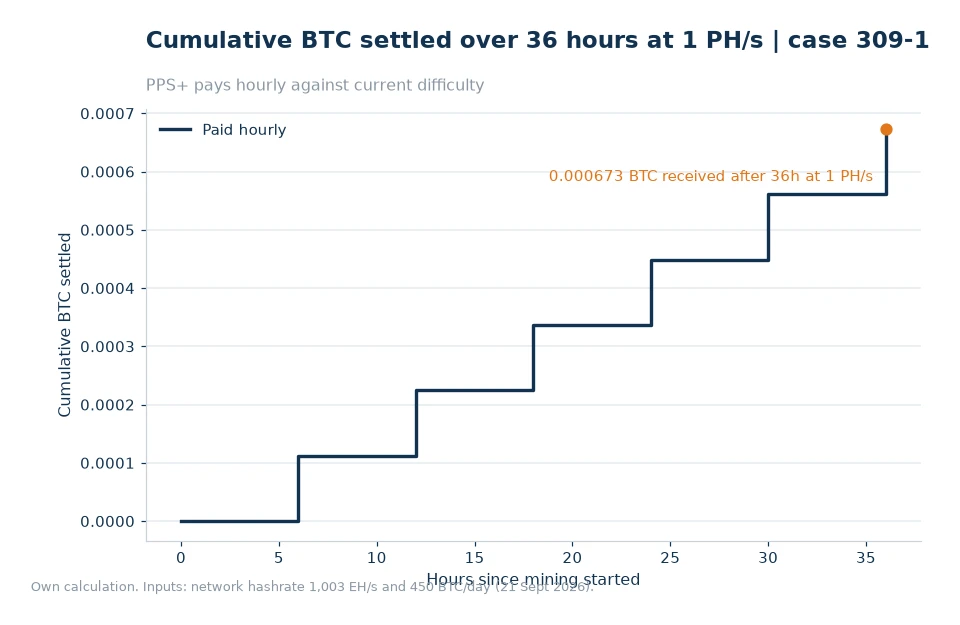
Where a relocation shows up in the credit line
Three signatures cover most of it. A flat start with a normal finish means the machines took longer to boot than expected, which is a commissioning issue and costs only the hours involved. A normal start with a sag in the middle means something tripped, and the site's own logs will say what. A uniformly low line means the units are running below their configured frequency, usually because a power supply is being asked for more than the feed will give.
The fourth signature is subtler: normal credits with a hashrate that will not settle. That combination often means workers are being created under new names and old ones still appear, so the per-worker view is split while the total looks fine. Clean up the names on the first day, before the monthly report has to explain two sets of rows, and confirm the payout address in the multi-currency wallet has not been touched by whoever rebuilt the configuration.
Write down what the move cost
Keep a single page per move: the date the last share arrived at the old site, the date the first arrived at the new one, the hashrate at the pool and at the miner on the first full day, and the shortfall against 0.00067291 BTC. After two or three relocations the page becomes a planning tool, because the real cost of a move is the downtime plus the weeks of running slightly under spec that nobody noticed.
That page is also the right place to record what the site promised. Feed capacity, cooling headroom, a contact who answers at night. Comparing a promise with a 36-hour measurement is a short conversation, and having the measurement makes it a factual one. Paste the ViaBTC Mining Statistics capture beside it, so the hashrate and difficulty at the time of acceptance are attached to the move rather than remembered.
Frequently asked questions
How soon after a move should payouts look normal?
Within one hourly cycle if the machines are hashing and the workers are configured correctly. The full 0.00067291 BTC for 36 hours at 1 PH/s is the acceptance figure, and any shortfall inside that window is worth investigating rather than waiting out.
Does the new site's power quality change the credit?
Only through uptime and through the frequency the units can hold. A feed that sags may force a lower clock, which shows up as a uniformly low slope rather than as a gap, so compare the pool hashrate with the miner's own report before blaming the pool.
Should I switch payout mode after relocating?
Only if the plan changed. A move does not alter which mode suits an operation, and switching during a bring-up adds a variable to a measurement you are trying to keep simple. Settle the site first, then revisit the mode with a month of clean data.
Accept the site on a number, not a walkthrough
Walk the container, then close the door and let the pool do the judging. Thirty-six hours, six checkpoints, one shortfall figure. If the line matches 0.00067291 BTC at 1 PH/s, the move is finished and the next task is the ordinary one of watching difficulty.
Sources: ViaBTC pool state, statistics and wallet pages. Figures read 21 Sept 2026: network 1,003 EH/s, difficulty 132.76 T, 3.125 BTC subsidy per block, BTC $84,692. Published 24 Oct 2026[1].