
How Perfume Production Changed in Recent Years: A Field Report for Buyers
The last few years changed how perfume travels from a brief to a shelf, mostly in the buyer's favour: sampling loops got faster, compliance evidence got more transparent, and scent moved from a single product to a brand system. The practical result for a US launch is more information before the commit date — if you know what to ask for. This article maps what actually changed and what still has not.
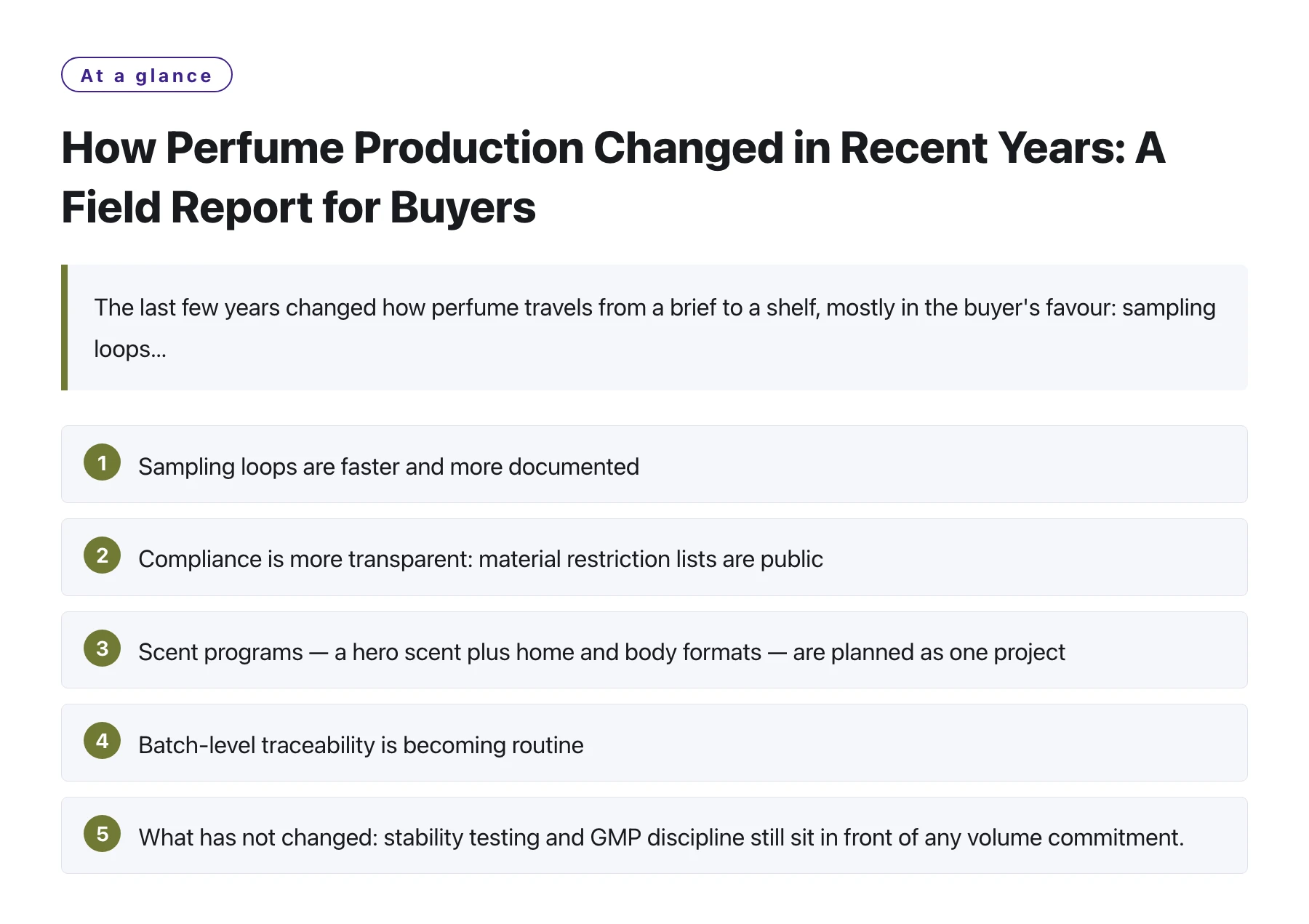
Key takeaways
- Sampling loops are faster and more documented; expect several recorded revision rounds rather than weeks of silence.
- Compliance is more transparent: material restriction lists are public, and buyers can request statements during development instead of at the end.
- Scent programs — a hero scent plus home and body formats — are planned as one project, which changes how quotes and lead times are structured.
- Batch-level traceability is becoming routine, so the questions that used to make factory visits awkward now have paper answers.
- What has not changed: stability testing and GMP discipline still sit in front of any volume commitment.
Anyone who sourced fragrance ten years ago remembers the shape of the process: send a brief by email, wait for samples, wait for the quote, wait for the run. The rhythm was slow, and most of the information arrived late.
The rhythm changed. Not because factories changed their chemistry, but because the process around it did — and a buyer who understands which changes are real can use them.
The changes buyers actually notice
The most visible change is speed and evidence in the sampling loop. Briefs travel as structured documents, feedback is exchanged in tracked rounds, and suppliers publish more of their scope in advance. Checking a manufacturer's official pages — Xuelei official site lists categories, services and certifications in one place — now answers questions that used to cost a sales cycle.
The second change is that compliance stopped being a closing ritual. Restriction lists are public documentation, statements can be requested early, and buyers arrive at the production decision with a paper trail instead of a promise [1].
Then and now at the factory level
| Stage | A few years ago | Now |
|---|---|---|
| Sampling loop | Long pauses; feedback by memory | Tracked rounds; documented versions |
| Compliance evidence | A certificate handed over late | Statements and lists available during development |
| Product planning | One scent, one SKU | Scent programs across formats planned together |
| Batch traceability | A factory-visit question | Documented records per batch |
| Communication | Email and phone | Structured briefs, shared files, faster responses |
The 'now' column is a description of what serious suppliers do today — and a checklist of what to ask for.
Why the changes matter for a US launch
More comparability, earlier
When scope and compliance are public earlier, quotes become comparable earlier. A launch team can shortlist suppliers on documentation before the first call, which removes a whole round of expensive discovery. Because the models also blurred — one factory may support a manufacturer that supports OEM and ODM — the model decision (who develops the scent) can be made explicitly instead of being inherited from the supplier's default.
Earlier red flags
The new transparency cuts both ways. A supplier that cannot produce a compliance statement or a batch record has less excuse than one did a decade ago, so the absence of documentation is itself a signal. The checklist does not get shorter; it just gets earlier.
Scent as a system
The biggest strategic change is that scent is planned as a portfolio: a hero fragrance with matching home and body formats, launched as one project. That reframes the supplier conversation from 'price per SKU' to 'one program, several formats, one set of documents', which changes lead times and minimums. Alongside that, scent spaces stopped being a novelty — museums and immersive installations became brand investments, and a factory with its own museum shows how far that shift has gone a museum built around smell.
What has not changed
None of this removed the fundamentals. Stability testing still decides whether a formula survives its packaging. GMP discipline still decides whether the batch matches the sample. The destination market's rules still decide what the pack must contain. The changes made these steps faster to verify, not faster to skip.
For direction on where the industry is headed, the signals are public: ingredient houses such as Givaudan publish their own views on scent trends and raw materials [2], and market research firms such as Mintel track how consumers buy fragrance across markets [3]. Reading those alongside supplier documentation gives a launch team both sides of the picture.
Read every 'now' item with one question: is this change written into the supplier's process and documents, or only into its brochure? Transparent processes leave paper.
Sources
- IFRA Standards Library (International Fragrance Association) —— The IFRA Standards Library lists the restrictions the fragrance industry applies to individual fragrance ingredients, based on safety assessments; it is the reference point for compliant fragrance formulation.
- Givaudan —— One of the largest fragrance and flavour houses; public material on fragrance creation, ingredient portfolio and market segments.
- Mintel Press Centre —— Mintel's press releases on consumer and beauty market research, including fragrance and personal care trend reporting.
Frequently asked questions
Have sampling times actually gotten shorter in fragrance manufacturing?
For most projects, yes, in the practical sense: the loop is structured into tracked rounds, briefs travel as documents, and feedback no longer waits for a phone call. The chemistry still takes what it takes, but the process around it is faster and better documented.
Are material restriction lists really public?
Yes. The industry body IFRA publishes its standards library openly, and the EU maintains a public ingredient database; both are used by formulators and buyers. That makes compliance a verifiable conversation rather than a claim.
What is a scent program and why does it change lead times?
A scent program is a hero scent extended across formats — fine fragrance, home fragrance, body products — developed and produced as one project. It changes lead times because it is one brief, one set of documents and one production plan across several SKUs, instead of several parallel projects.
Has the role of the factory changed in recent years?
Many factories widened their role from production to the services around it: development, packaging design support, compliance documentation, even museums and education as brand assets. The buyer's practical takeaway is that scope is now a negotiating variable, not a fixed assumption.
What has not changed in perfume production?
The fundamentals: stability testing, GMP discipline, batch records and destination-market compliance. These still gate any volume commitment. The recent changes made them verifiable earlier; they did not make them optional.