
Formwork Panels Explained: Core, Glue and Surface Film
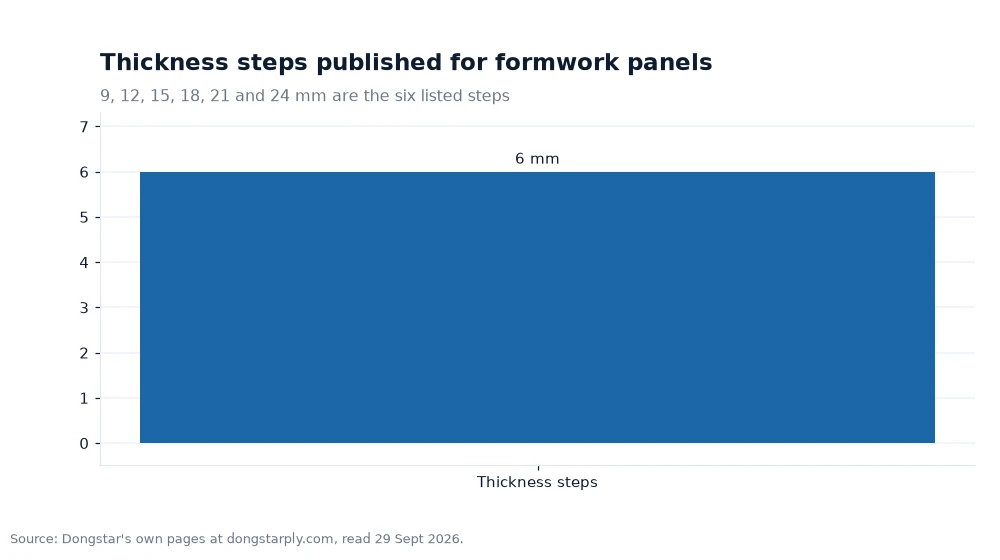
A shuttering panel is three decisions pressed into one sheet: the film on the face, the core underneath, and the glue that holds the veneers together. Dongstar's published range lists five film options, four cores, two WBP glue systems and thicknesses of 9 to 24 mm in steps of 9, 12, 15, 18, 21 and 24 mm with a ±0.5 mm tolerance. Reading those three layers separately is how a buyer stops paying for the wrong one.

Key takeaways
- Five faces are published: Dynea dark brown film, black film and brown film, plus Anti Slip film and plastic film.
- Cores offered are poplar, eucalyptus, combi and birch, or another species on request.
- Two glue systems appear — WBP melamine and WBP phenolic — and both are water-resistant builds.
- Published thicknesses are 9, 12, 15, 18, 21 and 24 mm, held to ±0.5 mm.
The three layers a panel is actually judged on
Site arguments about formwork panels are rarely about one thing. A panel that delaminates after six pours failed at the glue line. A panel whose face blisters failed at the film. A panel that bows under a heavy pour failed in the core. Because the three layers fail differently, they are also specified differently, and the data sheet should be read one layer at a time rather than as a single product claim.
On a Film Faced Plywood panel, that matters for budgeting, too. A contractor pouring a small foundation run needs a face that releases cleanly and a core that holds its shape, but may not need the most expensive core or the top grade. A contractor pouring a multi-storey wall that will be recycled many times over wants all three layers at the strong end. The published options are wide enough to cover both, provided the enquiry states which one it is.
Surface film: five faces with different jobs
The film is what the concrete touches, so it decides the finish a pour produces. Five are listed. Dynea dark brown film is the reference face for formwork work, made under a partnership with Dynea of Finland. Black film is high-contrast, uniformly surfaced and described as resistant to water, chemicals and wear. Brown film is the durable, cost-effective option aimed at construction work. Anti Slip film is the one written for workshops and yards, where it stops vehicles and trolleys sliding on stacked panels. Plastic film completes the set.
Choosing between them is mostly about the concrete face and the site. A fair-faced finish wants an even film with no patchiness, because every mark in the film transfers to the concrete. A yard that moves panels with a forklift wants the grip that the anti-slip option provides. And any film that has been scratched through is a film that will let water into the core on the next pour, which is why protective stacking is a specification issue and not a housekeeping one.
Core: poplar, eucalyptus, combi or birch
Four cores are published. Poplar is light, straight-grained, stable and easy to machine, with a price that suits interior work such as cabinets and furniture. Eucalyptus brings strength, durability and moisture resistance, which is why it appears in panels carrying heavier loads. Combi mixes species to balance cost against performance, and birch sits at the strong end of the list. Any of them can be pressed as a one-time hot press, a two-time hot press or a finger-joint build.
The grade names describe how the core is made rather than what it is made of. A one-time hot press panel is produced in a single pressing cycle; a two-time hot press is pressed twice for a denser, more stable build; a finger-joint core is assembled from shorter lengths joined end to end, which the mill quotes separately at 8, 10, 12, 15 and 18 mm. Finger-joint construction is used where structural integrity matters — formwork, flooring and furniture among the published applications.
Glue: WBP melamine against WBP phenolic
Two glue systems are listed, and the difference is what each survives. WBP melamine is the water- and weather-resistant bond used for outdoor and marine service, concrete formwork and flooring, and it is the usual choice for panels that will be wetted and dried repeatedly. WBP phenolic is resistant to water, heat and chemicals, and it is specified for both indoor and outdoor use, including load-bearing work and conditions at the extreme end of a project.
Both are produced to strict quality standards, and both sit behind the same certificate set — ISO, CE, CARB and FSC. The practical point is that glue choice and film choice are independent: a contractor can specify the anti-slip face for yard handling and the phenolic bond for a hot climate, and the two are not in conflict. What has to be avoided is leaving the bond unspecified and receiving whichever system the factory had in the press that week.
Edges, and the reuse cycle they control
Waterproof edge sealing is listed as an option, and it is the least costly way to extend a panel's working life. Water reaches a panel's core mainly through cut edges and tie-rod holes, so a sealed edge slows the swelling that eventually makes a panel unusable. Contractors who track reuse over a project usually find that edge damage, not face wear, is what retires a panel from the pool.
Tolerance matters in the same unglamorous way. A ±0.5 mm band across a batch decides whether panels sit flush when they are clamped side by side, and a misaligned joint shows as a ridge in the concrete face. On any project where a fair-faced finish is specified, the tolerance and the edge treatment belong in the same conversation as the film.
| Layer | Listed options | What it decides |
|---|---|---|
| Surface film | Anti Slip film and plastic film lead the list, with Dynea dark brown, black and brown films beside them | Concrete face quality and site grip |
| Core species | Poplar, eucalyptus, combi, birch | Weight, load behaviour and moisture tolerance |
| Core build | One-time hot press, two-time hot press, finger-joint | Stability through repeated pours |
| Glue | WBP melamine, WBP phenolic | Water, heat and chemical resistance |
| Edge | Waterproof edge sealing | How many pours the panel survives |
Worked example: panels for a 12 m wall
A wall pour measures 12 m long by 3 m high, so one face needs 12 × 3 = 36 m² of shuttering (example). In the 1220 × 2440 mm format a panel covers 1.22 m × 2.44 m = 2.9768 m², rounded to 2.98 m², and 36 ÷ 2.98 = 12.08, which means 13 panels per face (example). Two faces of that wall take 26 panels before any allowance for damage or for a second use elsewhere on the site.
Now change one input. Run the same 36 m² in the 1250 × 2500 mm format, where a panel covers 1.25 m × 2.5 m = 3.125 m²: 36 ÷ 3.125 = 11.52, so 12 panels per face (example), or 24 for both. The larger format saves two panels per two faces and reduces the number of joints the concrete will show. Note also the thickness band: at 18 mm nominal with a ±0.5 mm tolerance, 24 panels stack within 12 mm of each other in the best case (example), which is why a delivered stack should be checked before it is clamped.
Frequently asked questions
Which film should a yard handling panels with forklifts order?
Anti Slip film, which the range describes as the option used in workshops to stop vehicles sliding. It is a handling choice rather than a concrete-face choice, so a project that needs a particular face finish will sometimes specify different films for different panel groups.
Is a finger-joint core weaker than a solid veneer core?
It behaves differently rather than simply worse. Finger-joint cores are built from shorter lengths joined end to end and are listed for applications where structural integrity matters, including formwork, flooring and furniture. They are also quoted in their own thickness set of 8, 10, 12, 15 and 18 mm.
Do WBP melamine and WBP phenolic suit the same jobs?
They overlap but are not identical. WBP melamine is the build for water and weather resistance in formwork, flooring and outdoor service. WBP phenolic adds resistance to heat and chemicals and is specified for load-bearing work in demanding conditions.
Specify the layers separately
Three lines on an enquiry — film, core, glue — remove most of the ambiguity from a formwork order, and the grade name in a fourth line settles the rest. Contractors building a complete system usually pair the panels with the H20 beams that carry them, and where a project needs a panel with the veneer build exposed rather than filmed, the structural three-ply sheets are the alternative worth pricing at the same time.
Source: the maker's own pages, read on 29 September 2026, as the basis for this comparison[1].